The AV platform by Kramer
Every space.
Every device.
One platform.
Panta Rhei covers the whole audio-visual lifecycle — finding the devices already on your network, organizing them by space, automating what happens in them, and telling you when something breaks. One login, one inventory, one set of permissions.
Cloud platform, local agents. A lightweight agent on each site does the work on the network; the console that drives it runs in a browser — in the cloud, or fully on premises if your policy requires it. Built and supported by Kramer — AV engineering since 1981.
Open like a management layer.
Deep like a vendor's own.
Every AV platform sits in one of two camps. A vendor's cloud knows everything about its own devices and almost nothing about anyone else's. A management layer sees every vendor — through their clouds — and owns nothing on the wall. Panta Rhei is built to be both.
- Any device. Through a driver, not a connector.
A site agent on your network discovers, monitors and controls any IP device from any vendor — not a summary fetched from that vendor's cloud. No driver yet? Add one.
- It acts. It doesn't just alert.
One low-code script, published once, runs across rooms in several buildings on several sites — executed locally, with one consolidated log. Control is joining the same engine.
- No processor per room.
Automation and control are orchestrated from the console and executed by the site agent. Nothing proprietary to buy, mount and program in every space.
- Cloud — or entirely on your premises.
The whole platform, console and agents included, can be deployed inside your own perimeter when policy requires it.
- From the console to the screen on the wall.
Session Manager on the display, the tablet and the door; AVoIP Manager; Kramer hardware configured and updated from the same console. The platform and the endpoints, from one maker.
- Built for the integrator business.
Every customer from one console, full isolation between them, remote reach into any device's own web interface, and a one-action handover when a contract ends.
| Capability | Vendor clouds | Management layers | Panta Rhei |
|---|---|---|---|
| Any vendor's devices | Own devices only | Via their clouds | Direct, through drivers |
| Acts on devices | Own devices | Reboot, power, per model | Any action the driver exposes |
| Cross-site automation | — | Scheduled commands | One script, many sites, one log |
| Runs on premises | Cloud | Cloud + appliance | Fully, if required |
| The room itself | Own rooms only | — | Session Manager, AVoIP Manager, hardware |
| Multi-customer isolation | Partial | Yes | Yes, with SI to IT handover |
Monitor and control anything. Configure and update Kramer. Run it wherever your policy says.
One login. One inventory.
One view of the estate.
Each area below is a service within Panta Rhei, sharing the same device list, the same space hierarchy and the same permissions. Turn on what you need.
Discovery
A local agent finds every IP device on the network, identifies it, and hands it to the cloud to be managed.
ExploreEnvironment and Inventory
Every site, building, floor, room and device in one tree — with the detail, status and warranty behind each one.
ExploreAVoIP Manager
Route, group and configure a fleet of Kramer streamers from one matrix — presets, video walls, KVM and access control.
ExploreMonitoring and Support
Sensor-based alerting across any vendor, incidents tracked to resolution, and updates rolled out from the cloud.
ExploreDevice Integration
Drivers for any IP device, Kramer gateways for the rest, credentials set once — then every service can speak to it.
ExploreAutomation and Control
Bind a driver once and the device can be automated by rule and controlled in the moment — across sites, from the cloud, executed by the local agent.
Session Manager
Turn any shared space into a locked-down, branded, one-touch environment — eight meeting platforms, any app, automatic reset.
Explore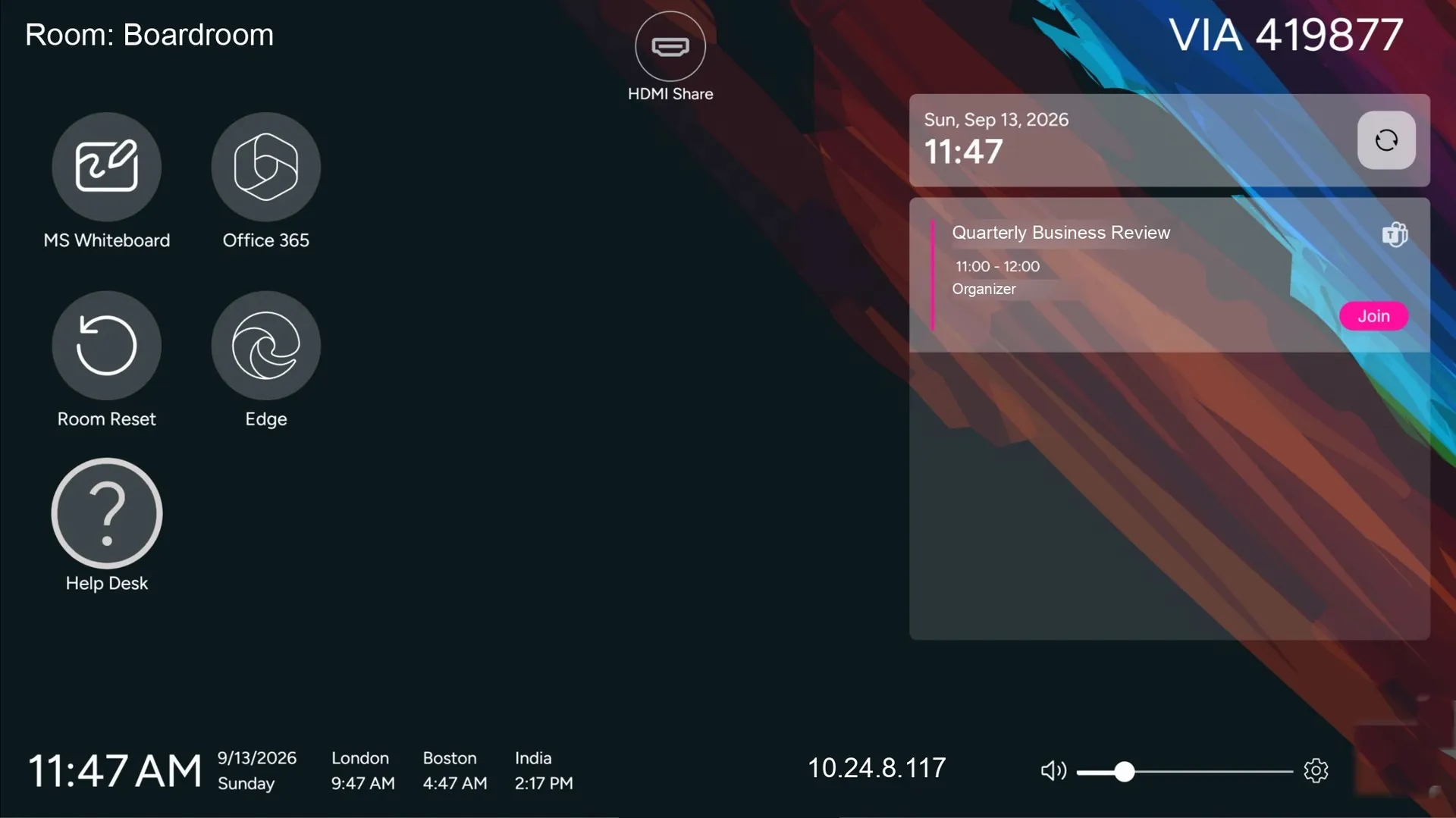
From an unknown network
to a room that runs itself.
The lifecycle in order. Each stage is the foundation for the next, which is why the platform is worth more than the sum of the services in it.
- Stage 1
Discover what is already there
A site agent scans the local network and identifies every IP device on it — vendor, model, address, the services it answers on. Nothing has to be entered by hand to begin.
Agent-basedIdentified by MACmDNS & UPnP metadata - Stage 2
Organize it by space
Devices land in a tree of environments, sites, buildings, floors and rooms. That tree becomes the address for everything after it — alerts, automation, configuration and reporting all point at spaces, not IP addresses.
Environment treeAuto-associationSpace summaries - Stage 3
Give each device a driver
Binding a driver to a device is what lets the platform read its state and send it commands. This is the step that makes the rest work, and it is deliberately vendor-neutral — any IP-connected device, from any vendor. Bind it once: monitor it, automate it, and soon control it.
Any vendorDrivers & profilesExtensible states - Stage 4
Watch it, and act when it breaks
Sensors raise alerts by severity, and an alert can become an incident that is tracked to resolution — assigned, commented on, and escalated to Kramer support if it needs to be.
Critical / Major / MinorIncident lifecycleTeams, Slack, ServiceNow - Stage 5
Control and automate across sites at once
Scripts are built in a visual, low-code editor and published to the agents. One script can target rooms in several buildings, on several sites, in one run — orchestrated from the cloud, executed locally, with a consolidated log of what happened where. Control is joining the same engine: the same drivers and the same agents, acting in the moment instead of by rule.
Visual editorScheduled or ad-hocCross-site in one runControl · coming - Stage 6
And make the room itself worth walking into
Session Manager is the part the people in the space actually touch — a branded, locked-down, one-touch environment on the computer already in the room.
8 meeting platformsKiosk lockdownAutomatic reset
Two things worth knowing up front: nothing reaches the field until it is published to the site agents, and only agents that are online receive it — offline sites collect the change when they reconnect. And while any vendor's devices can be discovered, monitored and controlled, configuration and firmware updates are Kramer devices only.
Three audiences, one platform.
The same device list and the same spaces, seen through three different jobs.
System integrators
Manage several customers from one console, with permissions scoped per customer and per service. Build a configuration once and carry it to the next site instead of rebuilding it.
IT and AV managers
One inventory of what you own, where it is and whether it is working — across vendors. Configure and update remotely rather than walking to the room.
The people in the room
A consistent interface in every space, whatever is behind it. One touch to start a meeting, one touch to share, and a room that resets itself afterwards.
Every customer from one console. Every device from your desk.
Remote device access
Reach a device's web interface without going on site.
Multi-vendor visibility
Every vendor's devices, across customer sites, in one place.
Service at scale
Work across customers while keeping their access separate.
Cloud-orchestrated.
Locally executed.
The architecture is the argument: a console that sees the whole estate, an agent on each site doing the discovery, the actions and the monitoring on your own network — and nothing proprietary in between.
- International cloudUnited StatesKramer-operated. Not AWS, Azure or Google Cloud.
- EU cloudEuropean UnionData stays in the region you choose.
- Your premisesInside your perimeterThe whole platform — console, agents, every service — with no cloud dependency.
Secure by design. Single sign-on per customer. Roles and permissions scoped per customer and per service. Tenants isolated from one another. Nothing reaches a site until it is published to its agent.
Console
Where everything is configured, monitored and administered. One login, one tenancy tree: customer, environment, space, device.
- Discovery
- Automation
- Control · coming
- Monitoring
- Discovery
- Automation
- Control · coming
- Monitoring
- Discovery
- Automation
- Control · coming
- Monitoring
- Any vendor — discovered, monitored, controlled
- Kramer — also configured and updated
See it running on your own estate.
A demo starts with whatever you already have — a site, a network and the devices on it. We will show you what the platform finds.
Already a customer? Sign in to the International cloud or the EU cloud.